Contents
Tata Motors’ $4.36 Billion Iveco Acquisition: A Bold Bet on Europe’s Commercial Vehicle Market
Tata Motors’ $4.36 Billion Iveco Acquisition: A Bold Bet on Europe
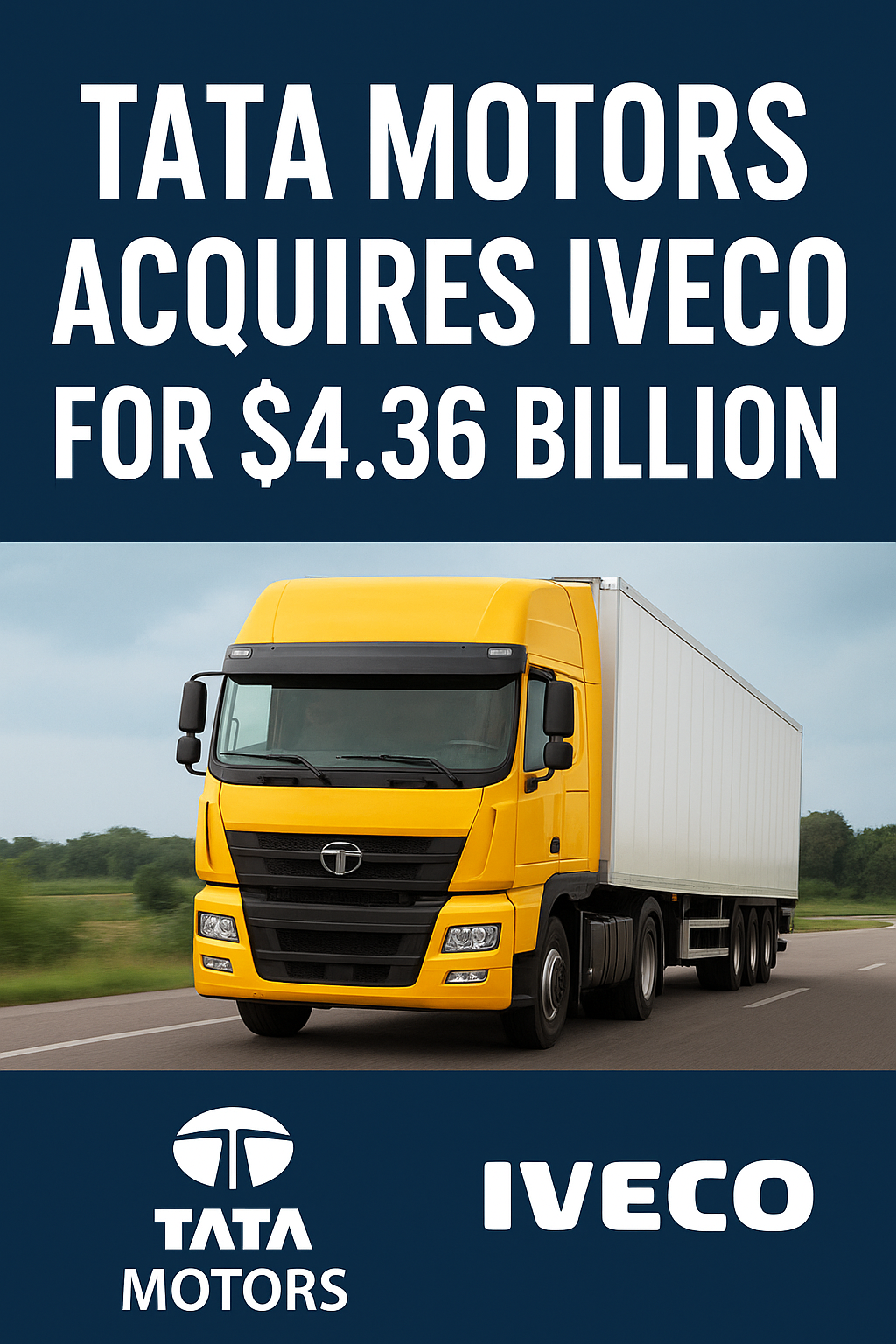
Tata Motors has announced a game-changing $4.36 billion acquisition of Italian commercial vehicle giant Iveco. This strategic move aims to expand Tata’s global reach, integrate advanced sustainable vehicle technologies, and challenge industry leaders in Europe, India, and the Americas.
Tata Motors’ $4.36 Billion Iveco Acquisition: A Bold Bet on Europe’s Commercial Vehicle Market
Tata Motors, in a decision that will establish the presence of the company across the globe, plans to acquire Italian commercial investments manufacturer Iveco in an all-cash offer worth 4.36 billion dollars. It is not only a headline generating deal, but a strategic bold stroke that may be as bold as the still remembered historic Tata deal of 2008, which took them to Jaguar Land Rover, but which may have far reaching consequences on its commercial vehicle activities. The transaction is funded on bridge of $4.5 billion, and Tata intended to make an equity raise in coming months in order to reduce some of the debts. Although this kind of step is bound to generate debates on the high rates of debt, the management of Tata appears satisfied that despite the financial risk, the potential of revenue in the long run is worth taking. It is estimated that the new operations might pump more than 25 billion dollars of revenues in Europe, India, and the Americas.
This acquisition would provide a strong beachhead in Europe rather than just a foothold in one as it would provide Tata Motors with a much needed access to Iveco, its manufacturing facilities, its vast dealer networks as well as its expertise of the sustainable transportation technology. Iveco sells state-of-the-art electric and natural gas-powered commercial vehicles, that would complement Tata on its quest to develop more environmentally friendly transport systems. Nevertheless, laying the path to follow is not smooth. Managing a global operation involving operations on different continents is not an easy procedure and involves a careful balance of geopolitical risks, different regulatory systems and different consumer preferences. Moreover, the European market of commercial vehicles is a mature but highly competitive business environment, to which such industry giants as Daimler, MAN, and Scania are already cemented.
This is perceived as a high-stakes gamble by the industry analysts, who reckon that this could catapult Tata Motors to the top echelons of production of commercial vehicles in the world. Produced with proper strategy, the deal might make Tata a formidable player who can rival the power of global giants not only in passenger cars but also in the heavy-duty and light commercial vehicles. The transaction is also, in line with the increasing desire of India in making outbound investments and international brand-building. The Iveco wager by Tata could as well become an example of how Indian businesses have used foreign acquisitions to acquire new technology, market access and brand prestige similar to that experienced by Jaguar Land Rover. In the immediate future the focus of the auto industry will be on how Tata transforms Iveco operations, who will control its expanded debt burden, and how it will situate itself in a new commercial mobility environment. This buyout could merely be the first step in a new era of the global success narrative of Tata-one which could very well define the future of the commercial vehicle business in more than one way.